
Why Perfect Productivity Is Not a Responsible Adult ADHD Treatment Goal
📌 Key Takeaways
The author recommends measuring adult ADHD progress through daily function, not perfect productivity, with goals shaped by each person’s life.
Measure daily function: Progress can include better focus, impulse control, consistency, relationships, and follow-through, even when daily output remains uneven.
Set personal goals: The author recommends goals based on real priorities, responsibilities, history, and context instead of one universal standard.
Track patterns over time: Patterns across weeks or months provide more context than one hard day, so uneven progress does not prove failure.
Use tools wisely: Planning apps may help occasional friction, but they cannot assess clinical concerns or explain persistent problems.
Better daily function matters more than flawless output.
Adults facing recurring focus or follow-through problems can use these ideas to prepare the function-first goal-setting guidance below.
~ ~ ~ ~ ~ ~ ~ ~ ~ ~ ~ ~ ~ ~ ~ ~ ~ ~
You finished four things on the list. The fifth sits there, undone.
The report you completed, the calls you returned, the errand you managed before noon: the completed tasks may barely register. Your attention may lock onto the one incomplete item, and a familiar thought follows. Nothing is actually getting better.
That thought is worth examining, because the standard behind it may not be fair. Starting projects but never finishing, missing deadlines despite sincere effort, and measuring every day against an impossible benchmark takes a toll. When the measure of an adult ADHD treatment goal is constant focus and flawless output, an unfinished task can begin to feel like a verdict on your worth.
No. Perfect productivity is not a responsible universal adult ADHD treatment goal. Meaningful goals are individualized and focused on daily functioning, such as attention, impulse regulation, consistency, and follow-through in situations that matter to the person. Progress may be gradual and contextual and should be discussed with a qualified provider.
Function-first ADHD treatment goals define practical changes an adult wants to pursue in focus, impulse regulation, consistency, and follow-through. They work like a map with personally relevant checkpoints rather than a switch promising perfect productivity. This framing helps you discuss situations that matter while recognizing that real improvement often happens in uneven steps. Because generic productivity tactics cannot evaluate clinical and overlapping factors, the practical next step is to bring those specific friction points and desired changes into a comprehensive, individualized discussion.
Why Productivity And Whole-Person Functioning Are Not The Same
Productivity measures output. Functioning is broader.
Whole-person functioning includes how you regulate attention across different settings, whether you can pause before an impulsive decision, how consistently you follow through on responsibilities that matter to you, and how you maintain relationships and personally meaningful activities. The National Institute of Mental Health explains that adult ADHD concerns can affect daily functioning across areas including work, home, and relationships, which supports a wider discussion than simply asking how many tasks were completed. A productive afternoon at work does not describe how the rest of your day went. And a lower-output morning does not erase the fact that you remembered a commitment, stayed patient during a difficult conversation, or caught yourself before acting on impulse.
When productivity alone defines progress, these broader changes go unnoticed. A person might be making real gains in consistency or impulse regulation while still having uneven days at the desk. That unevenness is part of the picture, not the whole verdict.
Why One Universal Standard Misses Personal Context
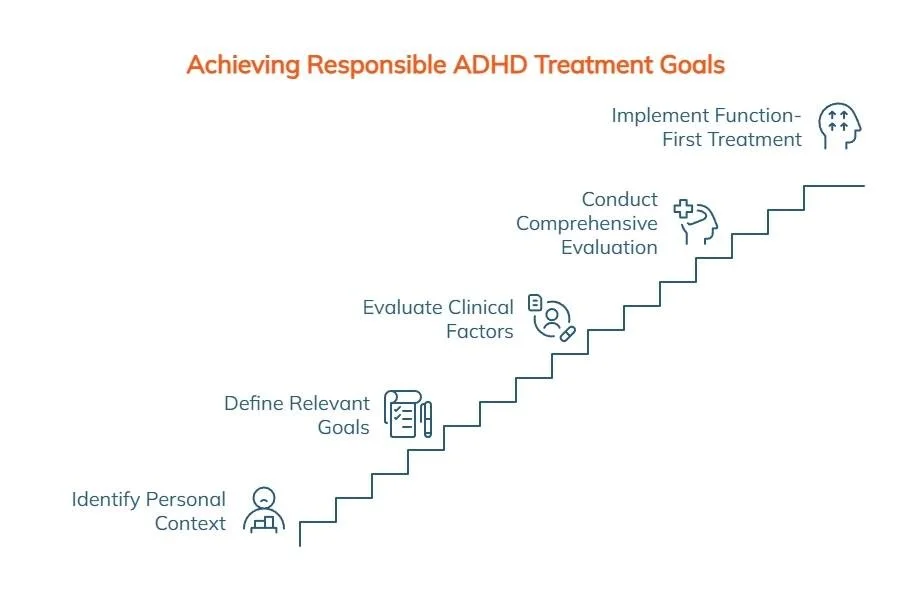
Universal perfection standards ignore individual context and priorities.
What counts as meaningful change depends on your work demands, home responsibilities, relationships, health and treatment history, current medications, family context, lifestyle, and the things that matter most to you personally. Two adults with similar focus issues may need entirely different goals because their lives, pressures, and priorities are different.
This is not about lowering the bar. Ambitious, high-performing adults may hold themselves to standards that leave no room for the kind of progress that reflects improvement. Setting individualized, function-first goals mean defining aims that are relevant and responsible for your situation. It means replacing a rigid finish line with checkpoints that reflect your actual life.
A licensed provider can help evaluate which clinical, contextual, or overlapping factors may be shaping the pattern. Conditions like anxiety, depression, or sleep disorders frequently mimic or amplify ADHD symptoms, making an accurate differential diagnosis critical before beginning any treatment. The CDC's overview of adult ADHD explains that diagnosis involves reviewing a person's history and considering other possible explanations. A comprehensive psychiatric evaluation supports this careful process rather than rushing toward a predetermined conclusion. It does not guarantee a diagnosis, and it does not make medication automatic.
What Function-First Adult Adhd Treatment Goals Focus On
Function-first goals connect care discussions to personally meaningful daily functioning.
Rather than asking "Is perfect productivity the right measure?", this approach starts with different questions. Which specific situations feel most disruptive? What would a meaningful change look like in those situations? What personal priorities should shape the conversation?
For example, a person might discuss more consistent follow-through on a personally important responsibility. Instead of a rigid benchmark like 'Work for 8 hours without distraction,' a function-first goal might be 'Use a timer to initiate priority work tasks within 15 minutes of arriving at the desk, three days a week. Another might focus on fewer missed commitments at home or work. Someone else might want greater ability to pause before an impulsive action that has caused problems before. These are illustrative, not prescribed. Each person's goals depend on their own context.
The key distinction: function-first ADHD goals are discussion points and personal progress markers, not guarantees. They do not determine diagnosis, and they do not replace professional evaluation.
Perfect Productivity Vs. Responsible Function-First Aims
This comparison is an educational reframe, not a diagnostic tool, checklist, scorecard, or promise of treatment results.
| Perfection-Based Myth | Responsible Reframe |
|---|---|
| Progress means constant focus. | Progress is discussed through context-sensitive changes in situations that matter to the individual. |
| Every task should be completed flawlessly. | Goals can focus on personally meaningful consistency and follow-through without requiring perfection. |
| One productivity standard should apply to everyone. | Responsible aims account for individual priorities, history, context, and preferences. |
| An uneven day means treatment has failed. | Progress may be gradual and contextual and is best reviewed within an individualized care conversation. |
Common Pitfalls To Avoid When Defining Adult Adhd Treatment Goals
Some patterns can quietly undermine even well-intentioned goal setting:
Turning a goal into a moral judgment. Missing a deadline does not make you lazy. A treatment goal describes a functional aim, not a character test.
Using a single difficult day as the whole verdict. Looking at patterns across weeks or months can provide more context than a single difficult afternoon.
Treating an online symptom result as a treatment plan. A screening tool cannot evaluate your health history, current medications, family context, or the overlapping factors that a qualified provider would consider.
Assuming evaluation automatically means medication. It does not. A comprehensive psychiatric evaluation considers multiple possibilities, and medication is one of several options that may or may not be appropriate.
Expecting a generic productivity system to resolve clinical concerns. Planning apps and time-management strategies can help with occasional friction. But when the same focus or follow-through problem repeatedly disrupts responsibilities despite sincere effort, stronger demands for perfect productivity will not provide the needed clarity. The issue may involve factors that a productivity tool cannot assess.
That last point deserves emphasis. Progress can be meaningful even when productivity remains uneven, because responsible daily-function goals are tied to the most critical real-world priorities rather than to flawless output.
If you are starting to wonder whether a more individualized conversation might help, you can learn more about our ADHD services or contact us to learn more about how we approach ADHD care.
How To Bring Function-First Goals Into A Provider Conversation
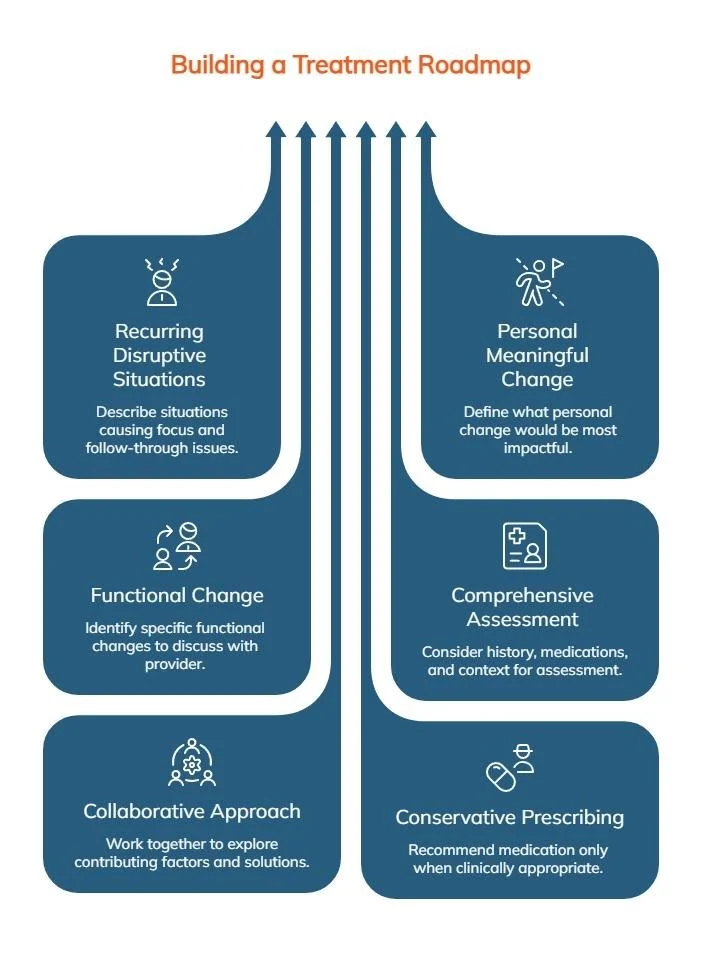
Collaborative goal discussions preserve agency and realistic expectations.
You do not need a diagnosis or a detailed self-assessment before talking to a provider. You can start by describing the recurring situations that feel most disruptive, what you have already tried, and what personally meaningful change would look like for you. Three practical starting points can help frame that conversation: describe the situation where follow-through repeatedly becomes difficult, explain how the pattern affects a meaningful responsibility or relationship, and name the functional change worth discussing.
At Alpine Psychiatry, we consider your present concerns alongside physical and psychiatric history, current medications, family context, and other relevant factors. We use this process to explore what may be contributing to the pattern before drawing any conclusions. Our approach to care is individualized, collaborative, and conservative with prescribing—we recommend medication only when it is clinically appropriate.
The map idea applies here, too. You are not flipping a switch to arrive at perfect productivity. You are identifying checkpoints that reflect your priorities, reviewing them in context over time, and adjusting the conversation as your understanding deepens.
We offer in-person psychiatric evaluation and medication-management care for ADHD at select locations in Pennsylvania and New Jersey, as well as virtual psychiatric care in Pennsylvania, New Jersey, New York and Delaware. Insurance participation and coverage vary by plan, service, and location, so contact your insurer to verify your benefits and financial responsibility before your first visit.
If recurring problems with focus or follow-through are affecting your daily life, you can learn more about our ADHD services or contact us with questions about individualized care.
Disclaimer: This article provides general information about responsible adult ADHD treatment goals for educational purposes. Individual circumstances vary significantly based on factors such as daily-function needs, health and treatment history, current medications, family context, lifestyle, and personal priorities. For personalized guidance on defining goals and deciding whether evaluation may be appropriate, consult a qualified mental health professional.
About the Alpine Psychiatry Insights Team
The Alpine Psychiatry Insights Team is our dedicated engine for synthesizing complex topics into clear, helpful guides. While our content is thoroughly reviewed for clarity and accuracy, it is for informational purposes and should not replace professional advice.