
How to Turn Focus and Follow-Through Problems into Useful ADHD Treatment Goals
📌 Key Takeaways
The author recommends turning repeated focus problems into specific situations, realistic goals, and questions for a qualified provider.
Start with one situation: Name where work stalls and which responsibility suffers, so a provider can understand the problem clearly.
Choose realistic change: Focus on making daily tasks easier or more consistent, rather than demanding perfect attention or productivity.
Bring one clear question: Ask what context matters and how to define progress without assuming ADHD causes the pattern.
Treat goals as discussion points: Prepared goals can organize an appointment, but they cannot diagnose ADHD or select an individual treatment plan.
Consider the whole context: A qualified clinician may review health, sleep, stress, medications, and other factors before recommending care.
Specific situations turn self-blame into useful provider conversations.
Adults facing repeated focus and follow-through problems will prepare more clearly for the practical conversation guide that follows.
~ ~ ~ ~ ~ ~ ~ ~ ~ ~ ~ ~ ~ ~ ~ ~ ~ ~
The project folder is open, untouched for the eleventh day. Two tabs over, a calendar reminder you dismissed yesterday still has a red badge, and the responsibility attached to it is now overdue.
You know what keeps going wrong. Naming what you want to change is harder. When this happens, it is easy to blame a lack of willpower. But recurring roadblocks often require clinical strategies, not just harder effort.
To turn focus and follow-through problems into useful ADHD treatment goals, start with one affected daily situation, describe the practical change you hope to discuss, and bring a question to a qualified provider. These discussion points can clarify your priorities, but they do not diagnose ADHD or determine an individualized treatment plan.
A function-first approach to ADHD treatment goals centers on practical changes an adult wants to pursue in attention, impulse regulation, consistency, and follow-through. It works like a map with personally relevant checkpoints rather than a switch promising perfect productivity. This framing helps you discuss situations that matter while recognizing that progress may be gradual and contextual. Because generic productivity tactics cannot evaluate clinical and overlapping factors, the practical next step is to bring those situations and desired changes into an individualized discussion.
Focus And Follow-Through Problems Become Clearer When You Name The Affected Situation
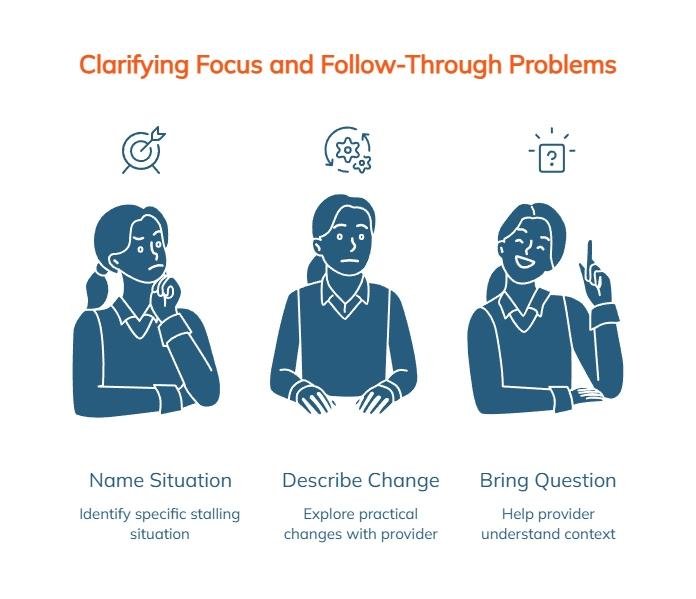
A common starting point is a broad concern: “The goal is to focus better.” That gives a provider very little to work with because it does not describe where the friction appears or what responsibility it disrupts.
A more useful starting point is a three-part translation:
Name one affected situation where things repeatedly stall or break down.
Describe one practical change you would like to explore with a provider.
Bring one question that helps the provider understand your context.
This is not a diagnostic exercise. Naming a situation does not prove ADHD or determine a treatment plan. It organizes a conversation, so your concerns are easier for a qualified provider to interpret.
A vague goal may reflect uncertainty about how to describe the problem, not a lack of effort or motivation. Self-directed productivity strategies can help with occasional friction. When the same problem repeatedly disrupts responsibilities despite sincere effort and ordinary adjustments, a provider conversation becomes more practical than stronger demands for perfect productivity.
Affected Daily Situations Give Adhd Treatment Goals Useful Context
Saying “focusing is difficult” describes a feeling. Saying “a work project stalls every time the next step needs to resume after an interruption” describes a situation a provider can ask follow-up questions about.
Situations carry context: where the friction happens, how often it recurs, and which responsibilities it touches. To name an affected situation, consider the setting, the responsibility, and what part of the process repeatedly becomes difficult. You do not need to explain why it happens. That interpretation belongs to a psychiatric professional, not to an article or a self-assessment.
How Can You Describe What You Want Help With?
Describe the setting, the responsibility, and what repeatedly becomes difficult. For example: “Every time you sit down to finish a household task, you start but cannot sustain attention, and by Monday the task is still unfinished.” That is a situation, not a diagnosis.
The distinction matters because similar experiences can arise from different circumstances. Stress, sleep problems, health concerns, other mental health conditions, and changing life demands can all affect daily functioning. A qualified clinician must interpret the wider context before any clinical meaning can be assigned.
Desired Practical Changes Make Provider Conversations More Specific
Once you have named an affected situation, describe what you hope could become easier, more consistent, or more manageable.
Keep the change personal and realistic. Rather than “Never miss a deadline again,” a more useful starting point might be “Explore what more reliable follow-through on weekly work submissions could look like.” The first demands perfection. The second opens a discussion.
Myth: A responsible ADHD treatment goal should aim for perfect focus or productivity.
Fact: Function-first goals connect care discussions to practical, personally meaningful changes while allowing progress to remain gradual, contextual, and individualized.
You do not need to finalize a metric or timeline before your appointment. You and your provider can decide together how progress should be defined and reviewed. The CDC explains that what works best can depend on the person and their environment and that effective treatment plans include close monitoring, follow-up, and changes when needed.
A Three-Part Conversation Map Connects Daily Friction To Provider Questions
The table below illustrates how the three-part translation works. Each row is a hypothetical example for reading purposes only. It is not a checklist, score, worksheet, or diagnostic tool.
| Affected situation (illustrative) | Practical change to discuss | Question for a provider |
|---|---|---|
| A hypothetical work project is started repeatedly, but the next important step keeps stalling. | Explore what might support a more consistent return to the next meaningful step. | “What context would help you understand why this pattern keeps happening?” |
| A hypothetical calendar reminder is dismissed, and an important responsibility is still missed. | Discuss what a more reliable follow-through might realistically mean in this situation. | “How could we define a practical goal without assuming what is causing the problem?” |
| A hypothetical household task or personal message remains unfinished despite sincere intention. | Clarify which change would matter most to daily functioning or relationships. | “What wider health, treatment, medication, or family context may be relevant?” |
You and your provider may revise, reframe, or set aside a proposed goal after considering the full clinical picture together. Depending on the full picture, your provider might recommend cognitive behavioral therapy (CBT), traditional psychotherapy, medication, or lifestyle adjustments to help meet that goal. These examples can organize your thinking before an appointment; they do not replace what happens during one.
A Whole-Context Evaluation Comes Before Individualized Adhd Treatment Goals
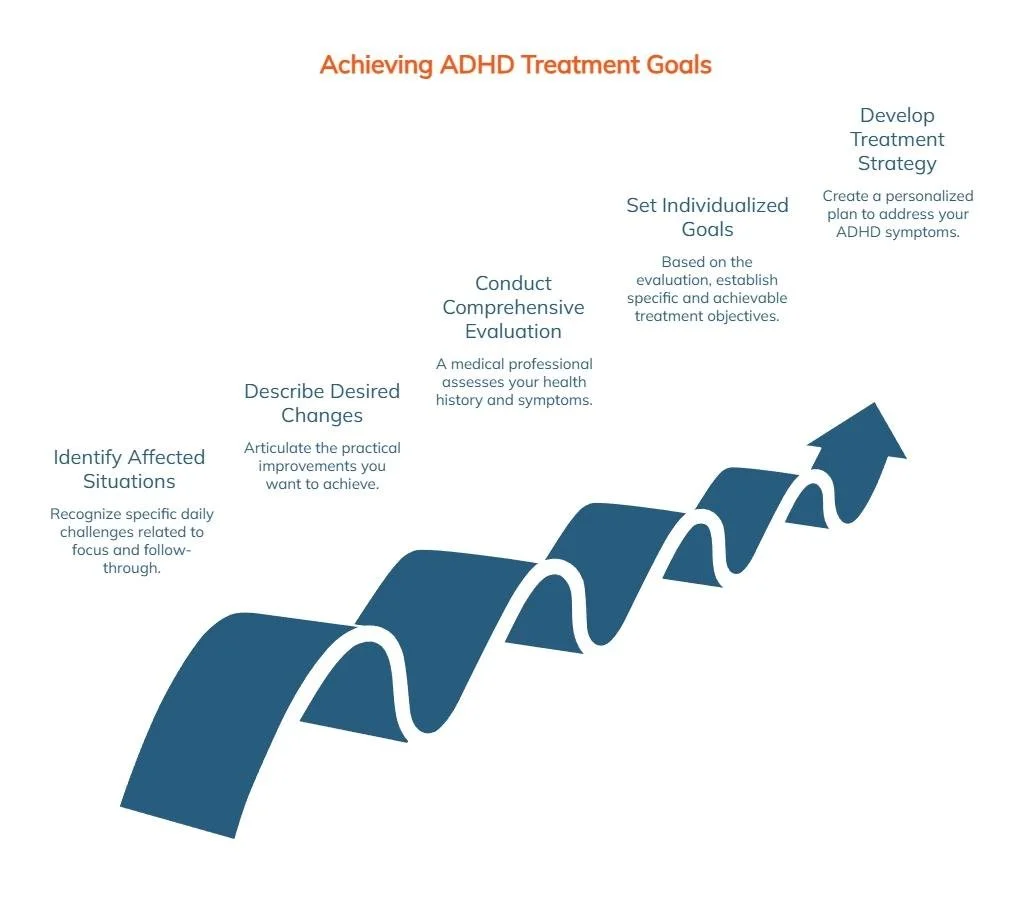
Naming affected situations and desired changes prepares you for a conversation. It does not complete one. To move from initial discussion to a definitive care strategy, a medical professional will integrate these symptoms with your comprehensive health history.
Our comprehensive psychiatric evaluation may consider present concerns, physical and psychiatric health history, treatment history, current medications, and family context. Recurring focus or follow-through problems can involve clinical, contextual, lifestyle, or overlapping factors that an educational article cannot distinguish. The National Institute of Mental Health explains that adult ADHD assessment considers how symptoms affect daily functioning and may involve ruling out alternative diagnoses. The Centers for Disease Control and Prevention likewise advises adults with focus-related concerns to begin by speaking with a healthcare provider.
Goals are separate from treatment decisions. Identifying these friction points serves as a starting point for dialogue, not a final clinical ruling on what interventions are appropriate. Evaluation, diagnosis, goal-setting, and treatment are distinct steps. If medication becomes part of the conversation, our approach is conservative prescribing, with medication considered only when clinically appropriate. The general principle of shared decision-making means your priorities, questions, and concerns are part of the process.
Clear Discussion Points Can Support A Lower-Pressure Next Step
Preparing for a provider conversation is an act of agency, not self-diagnosis. You started with a reopened project folder and a missed reminder. Now you have language: an affected situation, a desired practical change, and a question a qualified provider can address within your full context.
That shift, from self-blame toward clarity and agency, is the purpose of preparing discussion points. Bringing specific situations and realistic desired changes to a provider can make the first appointment feel less like a judgement and more like a collaboration.
If you want to understand the care options available for adult focus and follow-through concerns, learn more about our ADHD care.
We offer ADHD treatment and ongoing psychiatric care virtually throughout Pennsylvania, New Jersey, New York, and Delaware as well as in person at our psychiatry offices in King of Prussia, Exton, Wexford, Newtown, and West Chester, PA, and Mt. Laurel Township and Collingswood, NJ. We offer insurance-based care, subject to current plan participation and benefit verification. Confirm your plan-specific coverage and benefits before scheduling.
When you are ready to discuss your concerns, talk with a provider about your options.
Disclaimer: This article provides general information about turning focus and follow-through problems into ADHD treatment-goal discussion points for educational purposes. Individual circumstances vary significantly based on factors such as the situations affected, health and treatment history, current medications, family context, and personal priorities. For guidance tailored to your concerns and goals, consult a qualified licensed provider.
About the Alpine Psychiatry Insights Team
The Alpine Psychiatry Insights Team synthesizes complex topics into clear, helpful guides. Our content is reviewed for clarity and accuracy, but it is informational and should not replace professional advice.