
What Meaningful Progress Can Mean When ADHD Affects Daily Function
📌 Key Takeaways
Meaningful ADHD progress means practical, personal gains in daily life, not perfect focus or flawless productivity everywhere.
Measure daily function: The author recommends tracking meaningful responsibilities and relationships, since personal progress reveals more than a perfect task list.
Expect uneven progress: ADHD-related changes can differ across settings, demands, energy levels, and time without proving whether treatment works.
Value recovery skills: Restarting routines and repairing missed commitments may show progress, even when interruptions or forgetfulness still happen.
Prepare specific examples: The author recommends naming one problem, the desired change, and context before speaking with a provider.
Seek individual guidance: A qualified provider can assess health history, medications, sleep, family factors, and other concerns when planning next steps.
Progress means meaningful change, not perfect performance.
Adults facing recurring focus or follow-through problems will gain clearer ways to discuss daily challenges in the guidance below.
~ ~ ~ ~ ~ ~ ~ ~ ~ ~ ~ ~ ~ ~ ~ ~ ~ ~
One checkmark on a Tuesday.
You glance at the calendar on your kitchen counter. The bill that sat unopened for weeks actually got paid before the deadline. Not everything else is in order. The mail is still piled up, and the project you started last weekend is half-finished. But that single responsibility, completed without a last-minute scramble, looks different from how things usually go.
If you have adult ADHD (or suspect you might) and recurring problems with focus, follow-through, or finishing what you start have been disrupting daily life, that kind of small shift can be hard to trust. When the rest of the week still feels uneven, it is tempting to dismiss the one thing that did go differently. Does this even count as progress?
It can. When adult ADHD affects daily function, meaningful progress often looks like a gradual, personal change in a situation that matters, such as following through more consistently or recovering from a disruption more effectively. It is not a universal productivity score, and examples cannot determine an individual's diagnosis, treatment plan, or clinical goals.
A function-first approach to ADHD treatment goals focuses on practical changes an adult wants to pursue in focus, impulse regulation, consistency, and follow-through. They work like a route map with personally relevant checkpoints rather than a switch promising perfect productivity. This framing helps the adult discuss the situations that matter while recognizing that progress may be gradual and contextual. Because generic productivity tactics cannot evaluate clinical and overlapping factors, the practical next step is to bring those situations and desired changes into a comprehensive, individualized discussion.
Personal Progress Markers Are Not Perfect Productivity Benchmarks
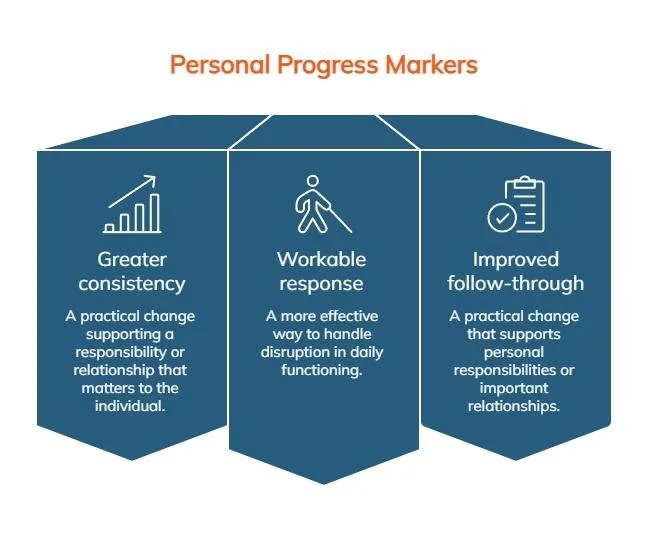
Measuring a good day by whether every task got finished without distraction sets up a standard that even adults without focus issues would struggle to meet consistently. Because ADHD impacts the brain's executive functions (the systems responsible for starting tasks, managing time, and regulating emotions), progress rarely looks like a perfectly straight line. A completed task list, flawless concentration across every setting, or equal performance at work and at home is not a responsible universal benchmark for adult ADHD treatment goals.
Personal progress markers work differently. They connect to specific situations where recurring difficulty is actually disrupting your daily functioning, not to an idealized output score. That matters because treating progress as all-or-nothing often deepens the self-blame that makes it harder to recognize real change.
Function-first goals keep attention on a practical question: what change would support a responsibility or relationship that matters to this individual? The answer may involve greater consistency, a more workable response to disruption, or improved follow-through. These are general principles, not a standardized set of goals. Individual circumstances, clinical interpretation, and recommendations vary from person to person.
Illustrative Examples Of Daily-Function Progress
The comparison below contrasts perfection-based thinking with personally relevant daily-function goals tied to responsibilities you care about.
| Daily Context | Perfection-Based Benchmark to Avoid | Illustrative Personal Progress Marker |
|---|---|---|
| Work or study responsibility | Finishing every task without distraction | Completing one priority more consistently or returning to it with a clearer recovery plan |
| Household administration | Never missing a deadline or appointment | Using a chosen reminder system more consistently for a responsibility that matters |
| Relationships | Never interrupting or forgetting a commitment | Pausing more often, repairing a missed commitment sooner, or following through on one agreed action |
| Health routine | Following every routine without disruption | Restarting a meaningful routine more readily after an interruption |
Notice that none of these markers demand perfection. “Never miss another deadline” leaves little room to understand what changed or which responsibility deserves attention first. “Use a chosen reminder more consistently for one important deadline” identifies a situation and a desired change without turning it into a clinical conclusion.
The same principle applies across the table. Repairing one missed commitment sooner may matter even when forgetting still occurs. Restarting a routine after a disruption may be meaningful even when consistency is not perfect. Each marker describes a change you could put into your own words when talking with a provider about what sustainable progress would mean in your life. Their meaning depends on your priorities, circumstances, and the goals you develop collaboratively with your provider.
Why Adult Adhd Progress May Be Gradual Or Context Dependent
Focus, impulse regulation, and follow-through do not operate identically across every part of life. You may find it easier to stay on track during a structured morning at work but struggle with household responsibilities by evening. A person may have more difficulty beginning an administrative task than responding to an urgent work request. A health routine may hold steady for two weeks and then fall apart after a stressful weekend.
Uneven progress alone does not show whether a particular treatment is or is not working. For some people, changes may look different across demands, energy levels, and environments. As the CDC notes, adult ADHD can affect daily life in multiple areas, and individualized treatment with ongoing monitoring is part of responsible care. NIMH explains that ADHD-related behaviors can occur across multiple situations, including home, work, and relationships. General information, however, cannot establish what a particular change means for one person.
One meaningful change in an area that matters can coexist with ongoing difficulty somewhere else. Someone may follow through on a work priority more consistently while household administration remains difficult. Another person may repair relationship disruptions sooner but still have problems beginning longer tasks. Neither pattern proves or disproves a diagnosis, nor does it establish on its own that a particular treatment is working. What these patterns do is give you something specific to bring into a conversation.
Progress can also be affected by context that an article cannot assess. Current demands, health history, medications, sleep, family circumstances, and overlapping concerns may all matter in different ways. For that reason, a modest change can be worth discussing without being treated as proof, a guarantee, or a final clinical judgment.
How To Bring Affected Situations Into A Provider Conversation
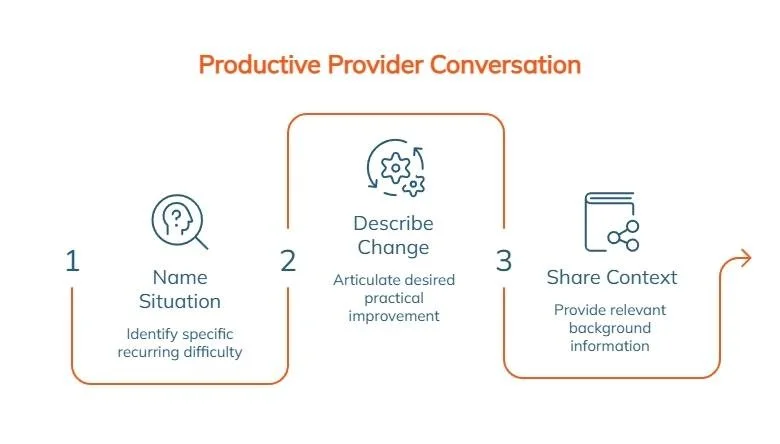
Defining the situations that matter to you, rather than arriving with a vague sense of frustration, can make an evaluation conversation more grounded and productive. A simple three-part preparation framework can help:
Name one situation where a recurring difficulty with focus, impulse control, or follow-through is affecting a responsibility, whether that is missing deadlines at work, starting projects but never finishing them, or losing track of commitments at home.
Describe the practical change that would feel meaningful in that situation, using your own words rather than a clinical benchmark.
Share context that may matter, such as when the difficulty is better or worse, what you have already tried, or how long the pattern has persisted. Share this context so you and your provider can discuss what it may mean and determine appropriate next steps together.
A comprehensive psychiatric evaluation may consider your present concerns, physical and psychiatric history, current medications, family context, and overlapping factors. Evaluation does not automatically mean starting medication. Recommendations are individualized.
At Alpine Psychiatry, we are clinician-owned and take a whole-person approach to adult ADHD care. When medication is clinically appropriate, we prescribe conservatively. When coordinated psychiatry and therapy may be helpful, we offer that integration. Therapy is available virtually in Pennsylvania and New Jersey only. We offer in-person ADHD treatment and medication management in King of Prussia, Exton, Newtown, Wexford, and West Chester, Pennsylvania, and in Mt. Laurel Township and Collingswood, New Jersey. Virtual ADHD psychiatry is available in Pennsylvania, New Jersey, New York, and Delaware currently. We accept insurance, subject to current plan participation and benefit verification. Wherever you connect with us, we start with your concerns.
“Rob is the best. I feel like I got really lucky finding him. He’s knowledgeable and an excellent listener. As someone who’s new to exploring and treating the ADHD I’ve had my entire life, there were moments where I inevitably felt vulnerable or unsure of how to communicate my symptoms. Rob was able to listen and quickly identify a clear path forward for me. I cannot recommend him enough! To feel truly seen and heard by a professional—especially a male provider—is a uniquely wonderful thing to find.” — Frankie L.
A Realistic Next Checkpoint Is A Clearer Conversation
Go back to that calendar for a moment. The one checkmark did not transform everything. It did not need to. What it did was make one piece of meaningful progress visible in a way that a vague resolution to “be more productive” never could.
Progress is personal. It is contextual. And it is not a measure of your worth. The next checkpoint on your route map is not a perfect week. It is a clearer conversation: the situations that matter to you, the changes you want to pursue, and access to a provider who can help you decide what comes next.
If recurring focus or follow-through problems are affecting your daily life, learn more about adult ADHD care and how we approach individualized evaluation.
Disclaimer: This article provides general information about meaningful progress when adult ADHD affects daily function for educational purposes. Individual circumstances vary significantly based on affected situations, health and treatment history, current medications, family context, and overlapping factors. For personalized guidance tailored to your daily-function concerns and treatment goals, consult a qualified mental health professional.
About the Alpine Psychiatry Insights Team
Our Alpine Psychiatry Insights Team synthesizes complex topics into clear, helpful guides. While our content is thoroughly reviewed for clarity and accuracy, it is for informational purposes and should not replace professional advice.